
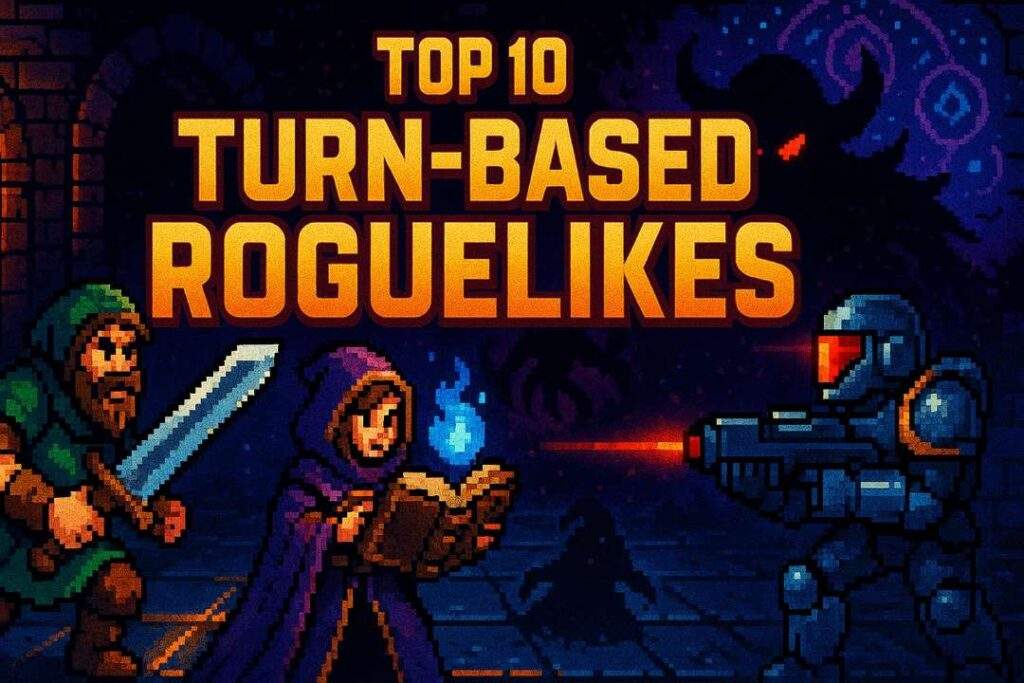
Ready to trade guesswork for sharp, turn-by-turn wins?
Choosing the right roguelike can spare you hours of trial-and-error and keep your coffee breaks as thrilling as your weekend marathons.
In this guide, you’ll see 10 top games weighed against eight practical benchmarks, visual clarity, run cadence, community strength, and more, so you can spot the perfect fit at a glance.
For this article, a game had to meet three simple rules:
- Turn or phase-based combat. Every action happens in discrete steps, giving you time to think before you act.
- Procedural runs with real stakes. Death resets most or all progress, so decisions carry weight from the first room to the final boss.
- Minimal meta-progression. Long-term unlocks can exist, but the thrill should come from making the right calls during a run, not grinding for permanent power.
What Makes a Good Turn-Based Roguelike Game?
A good turn-based roguelike game blends thoughtful decision-making with unpredictable, replayable challenges. It should offer:
- Clear, Tactical Combat: Every move matters, with visible enemy intent and no reliance on reflexes.
- Meaningful Randomness: Procedural maps, loot, and events keep runs fresh while providing tools to mitigate bad luck.
- High Replay Value: Multiple viable builds, classes, or strategies encourage experimentation and long-term play.
- Fair but Punishing Difficulty: Losses feel deserved and teach players something for the next run.
- Strong Progression Loop: Runs are short enough for repeat attempts, but rich enough to feel rewarding.
- Readable Visuals & Interface: Quick information access so planning isn’t bogged down by unclear UI.
- Active Support & Community: Updates, modding, or competitive features that keep the game lively and evolving.
Together, these elements turn each run into a unique puzzle and keep players coming back for “just one more try.” (Don’t let your friend who can’t end on a loss play these games)
Join the Insider List.
Get finished gameplay reveals, development updates, and early notice when the polished demo is ready.
No spam. Unsubscribe anytime.Without further ado, let’s dive into the best turn-based roguelike games!
1. Slay the Spire
- Theme & readability: Comic-book art keeps battlefields tidy, and the “intent” icons above enemies show exactly what they’ll do next, numbers included.
- Difficulty curve:
- First-run win-rate hovers around 10 %, so early losses are common yet instructive.
- Clear enemy cues make most defeats feel deserved rather than random.
- AI quality: Foes run scripted move cycles that you can learn and anticipate, turning each fight into a planning puzzle rather than a guessing game.
- Run-to-run cadence
- A successful climb typically lasts 40–60 minutes, with daily challenges or high-ascension attempts stretching toward 90.
- Auto-saves on every floor let you dip in and out without penalty.
- Randomness vs. planning tools
- After most combats, you choose one of three card rewards, guiding your deck toward a strategy.
- Relics that cancel curses or upgrade new cards blunt unlucky rolls.
- Build flexibility
- Four official characters plus popular mods such as Downfall add boss-playable heroes and entire campaigns.
- Viable decks range from endless zero-cost shivs to one-turn megablasts.
- Procedural variety
- Branching maps, random events, and daily mutators shuffle the experience every run.
- Steam Workshop hosts thousands of mods, new cards, relics, and rule-sets, that refresh the game long after the credits.
- Ongoing support
- MegaCrit’s monthly “Neowsletter” dev posts (most recently July 2025) show active balancing work and art previews while the team builds the sequel.
- Modders keep things lively, fan expansion Downfall hit version 5.3 on 12 April 2025 with a Snecko overhaul.
- Player base
- Averages ~20k concurrent users on Steam, peaking above 32k in February 2026.
Quick summary: A solo card-building climb where every fight hands you new tools, every relic shifts the odds, and enemies always show their next move. Victory comes from clever deck shaping, bold combo bets, and split-second risk calls during the hour-long ascent.
What makes it stand out: Brings board-game clarity to a card-based roguelike, where every map fork, card pick, and relic purchase has lasting consequences yet room for clever recoveries.
Ideal for: Anyone who loves tight tactical decision-making, brisk one-hour sessions, and an endless supply of fresh deck ideas to master.
Slay the Spire is also available on mobile and it made it also into our best turn-based mobile games list.
2. Balatro
- Theme & readability: Leans on a hazy retro-CRT palette that’s “eerily beautiful… like a poker game on a cursed TV” yet keeps suits, ranks and score math crystal-clear on every hand.
- Difficulty curve
- Early antes spike fast; many players burn their first dozen runs before cracking Ante 4, while boss blinds can demand six-figure chip totals in a single hand.
- Visible chip targets and advance warnings for bosses give you time to plot a counter, so losses usually feel like misplays rather than bad luck.
- AI quality
- No head-to-head opponent; challenge comes from ever-rising chip thresholds and scripted boss modifiers.
- Because the scoring maths is public and deterministic, each round feels like solving a puzzle rather than guessing an enemy pattern.
- Run-to-run cadence
- Standard eight-ante clears land around 30–40 minutes; endless mode or high-ascension pushes can stretch well past an hour.
- One-button restarts and automatic floor saves make it easy to squeeze a run into short breaks.
- Randomness vs. planning tools: Packs, vouchers and over 150 joker cards let you steer a shaky draw toward huge payouts, softening unlucky shuffles without killing the casino vibe.
- Build flexibility: Eight starting decks and hundreds of modifiers create wild approaches: single-card megahits, chip-farming discard engines, or multiplier-stacking straight sprees.
- Procedural variety: Each run remixes shop stock, joker pools, blind order and boss rules; daily challenges and Steam Workshop mods add extra twists for veterans.
- Ongoing support: Four free Friends of Jimbo DLC packs landed between Aug 2024 and 24 Feb 2025; a bigger 2025 content update promising “new ideas and strategies” is already in the works.
- Player base: Holds about 10k average concurrent players on Steam, with 14k active players peak in February 2026.
Quick summary: Poker hands become score-chasing puzzles: buy jokers, tweak your deck, and smash rising chip targets while boss blinds twist the rules. Thirty-minute runs mix lucky breaks with sharp maths and jackpot-size payoffs you engineer card by card.
What makes it stand out: Turns the familiar rules of poker into an addictive score-chasing sandbox where every shop visit can flip a doomed run into a record breaker.
Ideal for: Players who relish number-crunching deckbuilders, crave short “just one more hand” sessions, and don’t mind a dash of casino chaos.
3. Monster Train 2
- Theme & readability
- Four-floor board shown in crisp side-on view; clearer unit icons and damage previews make busy battles readable even with dozens of effects flying around.
- Art direction moves from hellish reds to cloud-soaked heaven, giving every clan its own colour palette while keeping card text legible.
- Difficulty curve
- Covenant levels 0 – 10 add modifiers step-by-step, so newcomers can finish Story mode while veterans chase brutal Titan wins.
- Community reports put a full clear of the main route at 45-75 minutes; many players needed a dozen runs before clearing Ante 4 equivalents.
- AI quality: No direct opponent: enemies ascend predictable lanes each turn, and a live damage forecast lets you plot outcomes before you play a card, more puzzle than guesswork.
- Run-to-run cadence
- Successful climbs usually last 45-75 min; autosaves at every station make it easy to pause mid-journey.
- One-button restarts drop you straight back at Ring 1 for that “just one more ride” loop.
- Randomness vs. planning tools
- Branching map offers twin upgrade routes each ring, duplicate, purge, heal, or shop, so you shape luck instead of suffering it.
- Deterministic damage previews, card upgrades, and event choices give constant chances to salvage shaky draws.
- Build flexibility: Ten clans (you draft two per run) plus hundreds of card upgrades support everything from Reanimate tanks to moon-phase spell loops.
- Procedural variety: Daily Challenges and Dimensional Challenges remix mutators and seeds every 24 h; random events and map forks keep runs from repeating.
- Ongoing support
- Patch 1.1.2 (5 June 2025) delivered balance tweaks, UI fixes, and localisation updates.
- Roadmap promises three free updates, starting with Lost Arsenal (Q3 2025) and a bigger content drop in Q4; devs celebrated passing 500k players in July.
- Player base: 3k concurrent players in February 2026, with an all-time peak of 18.5k on launch.
Quick summary: Battle upward through four stacked railcars, fielding a two-clan deck that packs monsters and spells into vertical lanes. Covenant levels and daily mutators keep each 50-minute ride new, demanding constant tweaks to placement and upgrade plans.
What makes it stand out: A vertical battlefield plus dual-clan decks create layered tactical play, while covenant scaling and daily mutators keep victory conditions fresh run after run.
Ideal for: Fans who enjoy one-hour strategic card runs, crunchy synergy hunting, and a steady stream of post-launch content to master.
4. Darkest Dungeon
- Theme & readability: Striking, comic–style gothic art and bold UI icons make turn order, health, and stress visible at a glance even in torchlight or total darkness.
- Difficulty curve
- Early missions kill off under-prepared heroes quickly; first campaigns often run 100-plus in-game weeks before the final descent.
- Rising enemy damage and the stress system punish sloppy play, so defeats usually feel earned.
- AI quality: Foes follow weighted targeting rules, stress casters seek high-stress heroes, back-row snipers aim for low-HP targets, allowing players to read and counter patterns rather than guess.
- Run-to-run cadence
- A single short quest averages 10-15 minutes; long quests can stretch to 30.
- Full estate campaigns span 40–60 real-time hours, but constant autosaves let you dip in for one dungeon at a time.
- Randomness vs. planning tools: Accuracy rolls, critical hits, virtue/affliction checks, and hunger events add suspense, yet players steer risk via torchlight, scouting trinkets, and camping skills.
- Build flexibility: Fifteen hero classes with seven combat skills each, weapon/armour upgrades, quirks, and hundreds of trinkets enable countless party combinations, from bleed-heavy Hellion squads to riposte-centric Highwayman lines.
- Procedural variety: Room layouts, curios, and corridor events are freshly generated every dive (aside from a handful of fixed boss maps), keeping repetition low.
- Ongoing support
- SteamDB shows a balance-tuning patch on 29 July 2025, nearly a decade after release.
- Thousands of Steam Workshop mods, new classes, regions, and overhauls, add endless content; curated collections exceeded 300 mods as of April 2025.
- Player base: 5k average concurrent Steam users in February 2026, with 9,845 daily peak.
Quick summary: Guide flawed heroes through torchlit tombs where stress, wounds, and permadeath sting as hard as any foe. Success hinges on tempo control, trinket choices, and the nerve to retreat from a doomed delve before it claims the entire roster.
What makes it stand out: Blends brutal tactical combat with a unique stress mechanic and unforgettable narration, turning every torchlit corridor into a risk-reward mind game.
Ideal for: Players who enjoy punishing tactics, meaningful long-term campaign planning, and mod-driven replay value wrapped in grim Lovecraftian style.
5. Inkbound
- Theme & readability
- Story-book 3-D visuals set inside the living library of the Atheneum; colourful ability arcs and damage numbers stand out clearly, while enemies draw red threat cones to signal upcoming hits.
- Early reviews praise its “clear and readable little death dioramas,” even when several heroes act at once.
- Difficulty curve
- A single campaign run is meant to be beaten, but not on the first try; critics call the loop “equal parts entertaining and challenging,” and new players often need a few failed dives to beat the final chapter.
- Ranked difficulty tiers add harsher damage scaling and force tight positioning, keeping veterans busy.
- AI quality: Foes follow fixed routines and always telegraph the tile they will strike, turning most skirmishes into a forward-planning puzzle instead of guesswork.
- Run-to-run cadence:
- Developer posts confirm a “typical run takes about an hour,” while experienced soloists can finish in 30-40 minutes.
- Autosaves at every chapter gate let you quit mid-run without losing progress.
- Randomness vs. planning tools: Chapters shuffle upgrade shops, relic drops, and event rewards, but players spend limited “quill” rerolls to fish for missing pieces, steering luck rather than surrendering to it.
- Build flexibility: Eight playable classes as of the 1.1 update (June 2024) plus hundreds of synergetic relics allow teams to switch from crit-heavy Weaver webs to long-range Star Captain barrages on the fly.
- Procedural variety: Each book rearranges arena layouts, enemy packs, and mid-boss modifiers; four-player online co-op further mixes the experience because every teammate drafts different skills.
- Ongoing support: Regular patches continued until 14 May 2025, but in January, the studio told Discord members it would “no longer release new content” because sales fell short; servers and balance hot-fixes remain online, yet substantial additions are on hold.
- Player base: Steam averages about 54 average players in February 2026, with a recent 24-hour peak of 138 and an all-time peak of 3,165 shortly after 1.0 launched.
Quick summary: Real-time movement blends with turn-based precision: dash, aim, and strike with up to three allies, then freeze the action to rethink. Hour-long runs reward daring positioning and inventive relic chains, even if fresh content has paused for now.
What makes it stand out: Blends action-game pacing (move in real time) with turn-based precision, then lets up to four friends chain abilities at once, few roguelikes feel this punchy while still rewarding careful planning.
Ideal for: Players who enjoy tactical card-free builds, co-op strategising, and tight one-hour sessions, provided they’re okay with a modest, steady-state update cadence rather than a growing feature list.
6. Stoneshard
- Theme & readability: Gritty pixel-art lets you spot body-part damage, pain and morale icons at a glance, even when the torchlight fades.
- Difficulty curve
- The opening caravan teaches basics, then the first contract can wipe a party in minutes; community posts suggest most rookies need a dozen attempts before clearing the Mannshire arc.
- Injury, hunger and sanity layers punish sloppy choices, so steady scouting and rest are key.
- AI quality
- Each foe follows published vision, noise-sensing and skill scripts, archers kite, wolves flank, so you can predict and counter once patterns are learned.
- A 2025 patch widened sight-lines and re-tuned path-finding, making reckless plays far riskier than in early builds.
- Run-to-run cadence
- One contract dungeon takes roughly 25–40 minutes; hauling loot to town adds another five.
- Finishing every boss and settlement in the current EA map averages 20–30 hours, though permadeath restarts push playtime higher.
- Randomness vs. planning tools: Accuracy rolls, critical hits and loot drops keep tension high, yet torches, herbs and camp saves let careful players tilt odds back in their favour.
- Build flexibility: No fixed classes: any origin can mix dozens of weapon, magic and survival trees, from dual-axe berserkers to electromancy archers.
- Procedural variety: Dungeon layouts, monster packs and shrine events reshuffle on each respawn, so even the same ruin feels fresh.
- Ongoing support
- Five updates in 2025 so far, latest devlog “Caves” landed 30 Jul 2025; psyche overhaul and new magic school arrived with patch 0.9.2 in March.
- The April roadmap outlines three more milestones before version 1.0.
- Player base: Steam averages about 900 concurrent players in February 2026, peaking at 1.7k; all-time peak sits at 10,738 at launch.
Quick summary: A gritty survival trek where broken bones, bleeding, and panic matter as much as blades or spells. Each contract dungeon is a tense push-your-luck loop of scouting, scarce supplies, and life-saving campfires.
What makes it stand out: Its pain, fracture and psyche systems turn every skirmish into a tense resource puzzle, one bad cut can doom a veteran.
Ideal for: Tacticians who relish harsh survival rules, granular character builds and contract-length sessions they can squeeze into a busy week.
7. For The King
- Theme & readability
- Hex-grid overworld with crisp icons shows danger zones, towns, and party status cleanly on a single screen.
- Storybook low-poly art keeps text and dice rolls legible even in torchlight dungeons.
- Difficulty curve
- A ticking Chaos Meter raises enemy strength every few rounds, pushing newcomers to learn tempo control early.
- Full-campaign clears on standard rules generally take 5–12 hours, but fresh parties often fall long before the final boss.
- AI quality: Foes use weighted targeting: many monsters prefer the weakest or lowest-HP hero, giving pattern-savvy teams room to counter.
- Run-to-run cadence
- One short dungeon or side quest fits into a 10–30 minute break; a whole adventure unfolds across several sessions.
- Automatic saves on every movement turn make it easy to pause and resume.
- Randomness vs. planning tools
- Every roll is visible, and Focus points let you lock in successes when it really matters, turning luck into a resource to spend.
- Chaos can be lowered by destroying generators or clearing quests, so smart routing can buy breathing room.
- Build flexibility: Thirteen hero classes plus hundreds of weapons, trinkets, and lore-store unlocks support wildly different party comps, from glass-cannon Hunters to full-tank Blacksmith lines.
- Procedural variety: Each new run shuffles the hex map, dungeons, curios, and enemy packs; campaign variants like Frost Adventure and Into the Deep bolt on extra twists.
- Ongoing support
- While IronOak’s main focus is now on For The King II, the original still sees event posts, discount campaigns, and community spotlights as recent as April 2025.
- A busy mod scene on Thunderstore, new game modes, QoL tools, and updates as recent as 1 August 2025, keeps content flowing.
- Player base: February 2026 had 537 average Steam concurrent players with 1,398 peak; all-time peak hit 9,993 in August 2023.
Quick summary: Tabletop tactics on a hex world: visible dice rolls and expendable Focus points let you force clutch successes as Chaos climbs. March your trio across a multi-session campaign, juggling quests, camps, and party synergy to reach the final showdown.
What makes it stand out: Mixes tabletop dice, tense time pressure, and strategic team building into a co-op adventure where every decision, move, fight, or camp, matters.
Ideal for: Groups who enjoy calculated risk-taking, long-form runs broken into bite-sized sessions, and tinkering with class line-ups until the final boss drops.
8. The Last Spell
- Theme & readability: Crisp, high-contrast pixel art and bold UI panels keep hundreds of units readable; damage, hit chance and status icons are always visible even when the purple mist rolls in.
- Difficulty curve
- Surviving the first town’s seven nights often takes 5–10 failed tries, and later maps can stretch a full clear to three-plus hours.
- Rock Paper Shotgun calls it “brutally tough,” a reputation the 2025 Apocalypse re-balances happily preserve.
- AI quality: Undead follow clear priorities, runners sprint for breaches, archers snipe low-armour heroes, and a live forecast shows exactly how much damage each tile will take, letting you plan around every swing.
- Run-to-run cadence: One night of defence takes roughly 5–10 minutes; a full town at normal Apocalypse usually lasts 2–3 hours, with auto-saves after every turn so you can drop in and out.
- Randomness vs. planning tools: Hero attributes, shop stocks and loot rolls differ each run, yet rerolls, Omens and buildable walls give steady ways to take back control.
- Build flexibility: No fixed classes: any hero can wield more than a hundred weapon skills and perk trees, enabling squads that swap seamlessly between cannon bombardment, lightning arcs or poison daggers.
- Procedural variety: Every restart shuffles town layouts, ruins, nightly spawn patterns and reward pools; daily challenges add extra mutators for score chasers.
- Ongoing support
- Five patches have landed in 2025 alone, the latest (v1.2.20.2, 30 July 2025) tweaked Apocalypse achievements and bug-fixed perks.
- A third DLC is in closed alpha, following April’s Elves of Amberwald paid pack and the free Apocalypse 2.0 overhaul.
- Player base: SteamDB shows ~839 average players in February 2026, peaking at 1,716; lifetime high stands at 6,755.
Quick summary: Defend a town against nightly hordes by drafting gear, erecting walls, and directing three heroes who can erase whole waves in a turn. Clear damage forecasts turn each kill zone into a tight geometry puzzle of angles and cooldowns.
What makes it stand out: The thrill of commanding three custom heroes against a thousand-strong horde, backed by a soundtrack that turns every last-stand volley into metal opera.
Ideal for: Players who relish meticulous turn planning, towering kill counts and long strategic runs they can pause between hectic nights.
9. StarVaders
- Theme & readability: Clean, grid-based sci-fi battles where unit positions and attack lines stay easy to read, even when your board gets crowded with threats.
- Difficulty curve: Early fights teach you the “move + card” rhythm fast, then the game starts demanding smarter positioning and tighter sequencing, one sloppy step can cascade into a bad board state.
- AI quality: Instead of twitch pressure, the challenge comes from enemy patterns, board control, and how well you set up turns that deny angles, block lanes, and prevent chain damage.
- Run-to-run cadence: Runs are built around short, snappy tactical encounters that keep you in “one more fight” mode, ideal for break-length sessions that can still turn into a full run if you have the time.
- Randomness vs. planning tools: You’ll see different cards and threats each run, but the game gives you enough tactical agency (movement + positioning + sequencing) that you can recover from imperfect draws with smart board play.
- Build flexibility: Multiple mechs and pilots push very different styles, so your “best” choices shift depending on which kit you’re piloting and what synergies you’re steering toward in that run.
- Procedural variety: As a roguelike deckbuilder, the core loop thrives on repeat runs: different card pools, encounters, and tactical problems that force new solutions rather than memorized lines.
- Ongoing support: Full release landed 30 April 2025, and it’s positioned as a modern, actively played deckbuilder tactics pick rather than a “museum piece” roguelike.
- Player base: 208 average players in February 2026, peaking at 323; lifetime high stands at 1,278 at launch.
Quick summary: A turn-based, grid-tactics roguelike deckbuilder where movement matters as much as your cards. You win by shaping turns, lining up hits, denying space, and turning small advantages into a clean board state before the run slips away.
What makes it stand out: It feels like “tactical positioning first, deck second,” your choices on the grid regularly matter as much as which upgrade you took.
Ideal for: Players who want Slay-the-Spire-style run structure, but with more board tactics, spacing, angles, and turn planning that rewards calm, methodical play.
10. As We Descend
- Theme & readability: Dark, end-times sci-fi/fantasy vibe with a clear, UI-forward presentation that keeps the important stuff readable, status effects, targets, and the immediate consequences of a decision.
- Difficulty curve: It starts manageable while you learn the game’s rhythm, then ramps as your choices compound, bad route decisions and shaky card packages tend to show up later when fights stop forgiving mistakes.
- AI quality: Pressure comes from tactical problems and resource constraints rather than surprise reflex checks, exactly the kind of “think first, act second” pacing your list is built around.
- Run-to-run cadence: The structure fits repeat attempts: you make a plan, see it tested, wipe (or win), then jump back in with a better sense of what actually works under run pressure.
- Randomness vs. planning tools: Runs remix the decisions and rewards you see, but success still comes from assembling a coherent plan, picks that support the same win condition instead of “cool stuff that doesn’t connect.”
- Build flexibility: It’s a deckbuilder roguelike at heart, so variety comes from how you shape your package and how you respond when the run offers you awkward pieces, do you pivot, or commit harder?
- Procedural variety: Designed for repeat play: the run structure and shifting rewards are the point, so you’re solving a new set of tradeoffs each attempt instead of repeating a fixed campaign script.
- Ongoing support: Launched in Early Access on 28 May 2025, which makes it a strong “new blood” entry for a 2025 roguelike list, especially if you want at least a couple of modern picks that still have room to grow.
- Player base: 46 average players in February 2026, peaking at 157; lifetime high stands at 460 at June 2025.
Quick summary: A turn-based roguelike deckbuilder built for repeated attempts: each run asks you to make tough choices, assemble a plan from imperfect options, and survive long enough for your strategy to come online.
What makes it stand out: It reads like a “new-gen” roguelike entry, Early Access, modern presentation, and a run structure that’s meant to be replayed and learned rather than brute-forced by grinding permanent power.
Ideal for: Players who want a newer roguelike (2025) with turn-based pacing and a run loop that rewards smart planning, plus anyone who likes checking back in as an Early Access game adds content and balance passes.
Honorable Mentions
Alina of the Arena
- Theme & readability
- Hex-grid gladiator pit shows every unit, push arrow and damage number on a single board, no camera fiddling needed.
- Enemy strikes are sign-posted with red tiles, so you can see trouble two steps ahead.
- Difficulty curve
- Expect several failed climbs before your first win; one player cracked Veteran after ~4 hours, others say a dozen tries for Hellwalker 1.
- Higher “Hellwalker” tiers pile on enemy health and extra modifiers, scaling well beyond a casual clear.
- AI quality: Foes follow transparent priorities, archers shoot the nearest target, brutes step in if they can knock you into walls, making pattern knowledge as important as deck strength.
- Run-to-run cadence: Each run is three arenas of 8–9 fights; a successful campaign usually lasts 30–45 minutes, and you can save-quit between bouts.
- Randomness vs. planning tools: Loot chests, mystery shops and event cards are random, but crowd-favour coins let you draft specific gear, and reroll tokens fish for combo pieces when luck stalls.
- Build flexibility: No classes, your style hinges on weapons and cards: dual daggers for flurries, sword-and-shield for counter decks, crossbows for kite tactics, two-handers for one-hit spikes.
- Procedural variety: Arena layouts, enemy packs and mid-run events reshuffle every restart; difficulty seeds and Steam Workshop skins (119 items and counting) keep visuals and challenges fresh.
- Ongoing support
- SteamDB lists the latest build on 15 October 2025, showing balance tweaks just months ago.
- While major content wrapped in 2024, the dev still posts bug-fix builds and moderates the official Discord.
- Player base: Around 25 average Steam concurrent players in February 2026; 24-hour peaks hover at 51, with an all-time peak of 1,636 set at 1.0 launch. Steam reviews: 92% positive from 3k+ players.
Quick summary: A one-fighter deck-builder where footwork is as deadly as any card. Sidestep, shove, and counter while forging a weapon-driven deck that can conquer an arena run in under an hour.
What makes it stand out: Turns every card play into a footwork puzzle, push, sidestep, or slam foes into each other, so positioning matters as much as damage numbers.
Ideal for: Tacticians who enjoy tight 40-minute runs, weapon-driven deck tinkering and learning enemy patterns until the arena feels like a dance floor rather than a brawl.
Crown Trick
- Theme & readability: Vivid, hand-drawn pixel art turns each nightmare room into a colourful chessboard, and the “time-only-moves-when-you-do” grid makes enemy intent easy to read before every step.
- Difficulty curve: Early floors teach teleport (“Blink”) escapes and elemental traps, but later bosses demand tight resource use; many players report a dozen failed outings before the first full-run clear.
- AI quality: Foes act only after your move, following fixed attack patterns, combat feels more like solving a live puzzle than trading blows at random.
- Run-to-run cadence: A successful dive through all four biomes lasts 60–90 minutes; auto-saves at each floor let you pause without penalty. (Based on dev notes and community runs.)
- Randomness vs. planning tools: Over 120 weapons, 60+ relics and environmental hazards spawn randomly, yet chosen familiars (captured elites) and elemental combos let you bend luck into lethal synergies.
- Build flexibility: Swap between swords, rifles, gauntlets or staves mid-run, mix relic sets for passive bonuses, and slot two familiars for room-clearing ultimates, viable paths range from blink-spam crit builds to burn-and-poison trap loops.
- Procedural variety: Every room layout, event choice and secret shop is freshly generated; puzzle shrines, risk-reward treasure vaults and hidden story notes keep repeated dives from blurring together.
- Ongoing support: Free “Requiem of Elements” DLC (2021) and balance patches culminated in a bug-fix update on 14 May 2025; no new content announced, but hot-fixes still land.
- Player base: February 2026: ~9 average players, 23 daily peaks; April 2025 event spike hit 274, and the all-time peak was 6,594 at launch.
Quick summary: Time freezes until you act, so every grid step counts, blink behind an enemy, ignite an oil pool, or unleash a familiar’s ultimate. Four biomes and a spread of weapons and elemental chains keep each 90-minute dive lively and tactical.
What makes it stand out: Its signature time-stop grid turns hectic roguelike rooms into tactical puzzles, rewarding careful positioning over raw reflexes.
Ideal for: Strategists who enjoy Hades-style room flow but want Slay-the-Spire-level planning, plus anyone craving hour-long runs they can pause on the way to work.
Not roguelike exclusive? Check our some of our picks for best turn-based strategy games worth playing.
Join the Insider List.
Get finished gameplay reveals, development updates, and early notice when the polished demo is ready.
No spam. Unsubscribe anytime.Comparative Breakdown
The roguelikes on this list share turn-based tension, yet they scratch very different itches once you look past the surface.
Below is a quick pairing-by-mood guide to help readers pick tonight’s download, or decide which two titles make a well-balanced rotation.
Lunch-Break Blitz
- Balatro – Thirty-minute poker marathons that restart with a single key press keep it perfect for bite-sized play.
- StarVaders – Quick, grid-based fights where positioning matters as much as your cards, perfect when you want a tight tactical hit in short sessions.
- Alina of the Arena – Three arenas, 40-minute clears, and instant retries make every attempt feel like a tight duel.
Why pick one? Both games waste no time on setup; you’re shuffling or sliding on turn one.
One-Hour Strategic Sprints
- Slay the Spire – A climb runs about 45–60 minutes, long enough to build a clever deck but short enough for an evening slot.
- Monster Train 2 – Similar run time, with dual-clan decks and a four-floor battlefield that asks you to think vertically.
- As We Descend – A newer deckbuilder run loop that rewards committing to a clear plan (or pivoting fast) when the run offers awkward pieces, built for repeat attempts and steady improvement.
When the clock says “week-night,” these two still fit before bed.
Deep Campaign Marathons
- Darkest Dungeon – A full estate push can chew up 40 hours, with stress, permadeath, and year-long calendars.
- Stoneshard – Permadeath survival runs sprawl across 30-hour maps, with body-part injuries and sanity to juggle.
Perfect for players who treat a roguelike more like a long-form RPG than a quick run.
Friends-Night Co-op
- For The King – Hex-grid overworld, dice rolls, and Focus points create board-game sessions that last several evenings.
- Inkbound – Up to four teammates unload abilities at once in hour-long story dives.
Voice chat, shared loot agonies, and big cheers when the boss finally drops.
Modding Playgrounds
- Slay the Spire – Thousands of cards, relics, and full campaigns on Workshop keep the meta shifting years on.
- Monster Train 2 – Steam Workshop already brims with new clans and mutators, and post-launch patches keep it stable.
If you love tinkering and community-made surprises, these two will keep giving.
Score-Chasing & Daily Challenges
- The Last Spell – Nightly kill counts and daily mutators push leaderboard climbers.
- Monster Train 2 – Dimensional Challenges refresh seeds every 24 hours for global ranking races.
Perfect for folks who enjoy “one and done” seeds that compare runs worldwide.
With these combos in mind, readers can shape a library that fits any schedule, whether they have ten minutes before a meeting or a whole weekend to dive deep.
Newcomer Advice
- Begin at the bottom rung. Every game here has a gentle starting tier, “Ascension 0,” “Covenant 0,” or plain “Normal.” Clear that first, then step up one notch at a time.
- Study the warning signs. Red tiles, intent icons, boss previews, stress meters: they’re there to help you plan. Spend a turn just hovering over widgets and reading tool-tips; the knowledge sticks.
- Treat early losses as scouting trips. Your first dozen runs will crash and burn. Instead of tilting, ask: Which cards felt dead? Which relic carried? Which enemy pattern surprised me? Jot down one lesson per defeat.
- Spend mitigation tools, don’t hoard them. Focus points in For The King, reroll tokens in Alina, quill rerolls in Inkbound, they exist to flip bad odds right now, not to gather dust.
- Use the community shortcut. Steam guides, Reddit deck dumps, and Discord pin messages can save hours of blind testing. Grab a starter build, then tweak it to your taste.
- Try a mod if frustration sets in. Quality-of-life packs, extra tool-tips, faster animations, clearer fonts, often exist for each title and won’t upset balance.
- Take breaks between long campaigns. Marathon runs in Darkest Dungeon or Stoneshard can sap focus. Slot a quick Balatro session between chapters to keep fatigue away.
Follow these habits and you’ll spend more time plotting clever turns, and less time staring at a game-over screen.
Conclusion
That concludes our list of the best turn-based roguelike games.
From Balatro’s 30-minute poker blitzes to Darkest Dungeon’s stress-scarred epics, today’s turn-based roguelikes match every mood and schedule.
Keep the benchmarks handy, lean on the newcomer tips, and swap titles as the day demands; whether you want a quick brain-teaser or a week-long campaign, the genre now hands you the reins one decisive turn at a time.
If you’ve liked this list, we’d suggest our list of the best online multiplayer strategy games.