
Looking for the best strategy games with Ancient Greece but not sure which ones are actually worth your time right now?
In this guide, we’ll walk through a hand-picked mix of grand strategy, 4X, RTS, and browser MMOs.
This list is not in a specific order as all have something unique to offer.
Take a look and find your game today!
Join the Insider List.
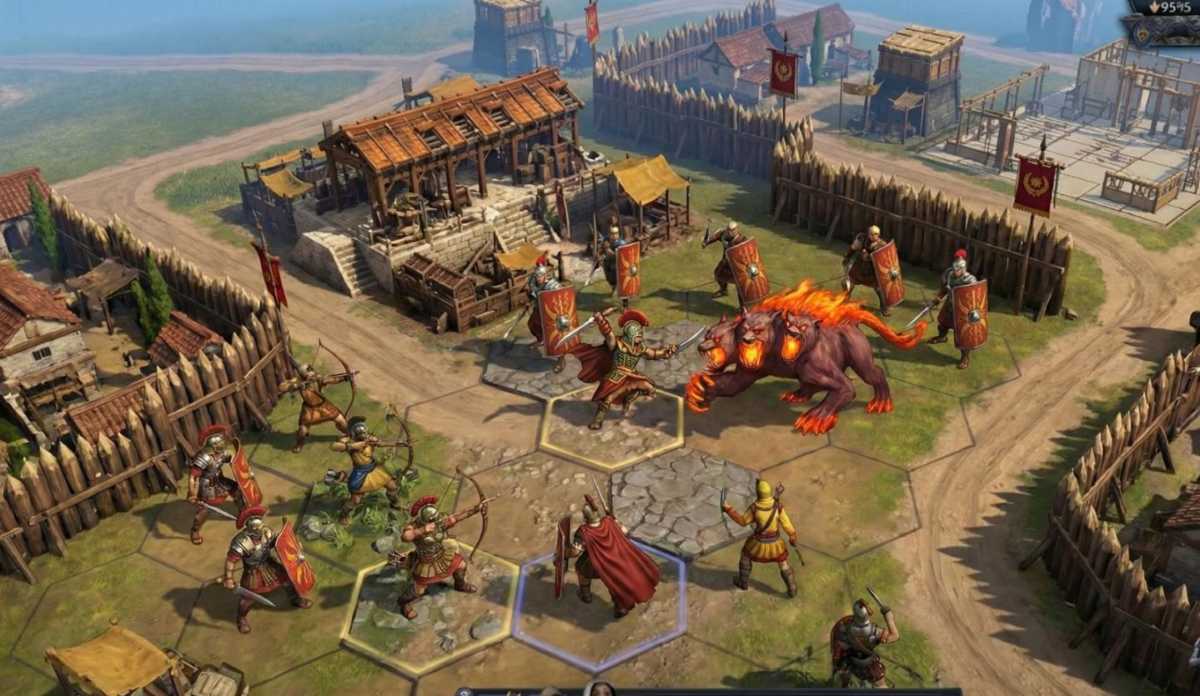
Get finished gameplay reveals, development updates, and early notice when the polished demo is ready.
No spam. Unsubscribe anytime.1. Total War: TROY
Genre & subtype: Grand strategy campaign with real-time tactical battles, set in a myth-inflected Bronze Age Ancient Greece and Troy.
Platforms: PC (Windows, macOS)
Summary
- Lead legendary figures from the Iliad such as Achilles, Hector, Agamemnon, and Odysseus in a full campaign across the Aegean.
- Build and manage a Bronze Age kingdom with a multi-resource economy (food, wood, stone, bronze, gold), diplomacy, and shifting alliances.
- Fight large real-time battles where formations, flanking, terrain, and morale decide whether your spearmen hold the line or break.
- Recruit “mythic” units inspired by Greek legends (Minotaur, Cyclops, Giants, Centaurs) that give your armies a terrifying centrepiece without turning the game into full fantasy.
- Experience both Greek and Trojan perspectives on the Trojan War, with campaign stories, objectives, and events that reflect each side’s worldview.
What makes it stand out
- Tight focus on the Trojan War and the Mycenaean Greek world rather than a broad era-spanning timeline, which keeps the campaign thematically sharp.
- “Truth behind the myth” approach: gods, monsters, and legends are present, but grounded in a gritty Bronze Age setting rather than high fantasy.
- Distinct heroes and factions with their own mechanics and battlefield roles, so choosing Achilles feels very different from playing Hector or Paris.
Ideal for: Players who enjoy long, thoughtful campaigns with cinematic real-time battles and want a Trojan War story that leans into Ancient Greek myth without leaving historical grounding behind.
2. Old World — Heroes of the Aegean DLC
Genre & subtype: Turn-based 4X historical strategy with narrative, scenario-driven campaigns centered on Ancient Greece.
Platforms: PC (Windows, macOS, Linux)
Summary
- Command legendary Greek leaders across six historical scenarios, from the Battle of Marathon and Thermopylae to the conquests of Alexander the Great and the wars of his successors.
- Relive key clashes with Persia: rally Athens against Darius I at Marathon, hold the pass as Leonidas at Thermopylae, fight the Persian fleet at Salamis, and strike back at Plataea.
- Guide Macedonia’s rise: survive as Philip II against stronger rivals, unify the Greek city-states, then take the role of Alexander to push into Asia in a chain of linked campaigns.
- Handle court intrigue and succession in a scenario that puts you in the shoes of Queen Olympias, juggling politics while preparing the young Alexander for rule.
- Get extra value in the standard sandbox: the DLC also adds the Hittites as a full civilization with three-man chariots, strong civic output, and special hill/forest movement traits.
What makes it stand out
- Scenario pack that covers over 200 years of Greek history in focused, replayable campaigns instead of a single open-ended map.
- Each scenario has its own rules, goals, and tempo, holding the line at Thermopylae, running a naval war around Salamis, or racing through Alexander’s lightning campaigns all play very differently.
- Blends Old World’s dynasty, event, and order systems with set-piece Greek stories, so famous battles come with character-driven choices and tough strategic trade-offs.
Ideal for: Players who like deep 4X strategy games but want tightly framed Ancient Greece scenarios, Persian Wars, Alexander’s campaigns, and Diadochi struggles, instead of another endless generic ancient sandbox.
3. Rome: Total War — Alexander
Genre & subtype: Real-time tactics and turn-based campaign expansion focused on Alexander the Great’s conquest of the Persian Empire.
Platforms: PC (Windows), macOS, iOS, Android
Summary
- Take control of Macedon as Alexander the Great in a dedicated story campaign that follows his rise to the throne and march east against Persia.
- Wage war on a new campaign map stretching from Greece into the heart of the Persian Empire, using the classic Rome: Total War mix of turn-based strategic moves and real-time 3D battles.
- Race against a strict objective: conquer 30 provinces, including key cities like Tyre, Halicarnassus and Babylon, within 100 turns, if the timer runs out or Alexander dies, the campaign ends in failure.
- Command a distinctly Macedonian army built around phalanx infantry and Companion Cavalry, facing Persians, Indians and steppe tribes in a sequence of increasingly demanding clashes.
- Replay famous engagements in six historical battles, from Chaeronea and the Granicus to Issus, Gaugamela and the Hydaspes, where Alexander’s death or retreat means instant defeat.
What makes it stand out
- A tight, time-pressured Alexander campaign designed as an “ultimate strategic challenge” for players who already know Rome: Total War, rather than a relaxed open-ended sandbox.
- Single-faction focus on Macedon gives a very clear arc: push out of Greece, smash Persia, and push on towards India, which suits the fast, aggressive style Alexander is known for.
- Classic Rome-era battles with thousands of soldiers on screen, now also available on mobile, so you can run a full Alexander campaign on PC or on the go.
Ideal for: Players who enjoy classic Total War and want a focused Ancient Greek campaign where they can blitz across Asia as Alexander the Great, juggling a strict time limit with big cinematic battles against Persia and beyond.
4. Imperator: Rome
Genre & subtype: Grand strategy and empire management in the classical Mediterranean, covering the Greek world, Hellenistic kingdoms and early Rome.
Platforms: PC (Windows, macOS, Linux)
Summary
- Start in 304 BC (450 AUC) with a huge map from Iberia to India, packed with hundreds of playable nations, including Macedon, Athens, Sparta, Epirus and dozens of smaller Greek states.
- Run a detailed population (“pops”) system, splitting people into nobles, citizens, freemen, tribesmen and slaves, each with their own output, happiness and political clout.
- Juggle character politics: families, rivalries, corruption and ambitions shape governors, generals and rulers, so keeping Greek elites loyal can matter as much as winning battles.
- Build cities and provinces around trade goods and military traditions, with Greek states leaning into hoplites, pike formations, and strong naval play while Rome and Persia lean in other directions.
- With the Magna Graecia content, Athens, Sparta and Syracuse gain unique mission trees and Greek deities, so you can run story-like campaigns for your favourite city-state.
What makes it stand out
- One of the most detailed Paradox maps ever: more than 7,000 cities and a dense cluster of Greek poleis, islands and Hellenistic realms that make Greek campaigns feel granular and local.
- Blends EU-style empire management (trade, buildings, diplomacy) with CK-style characters and families, so Greek runs are as much about senators and generals as they are about front lines.
- Extra Greek-focused DLC and community mods (like Magna Graecia and Imperator: Invictus) keep adding flavour, missions and polish to Hellenic campaigns.
Ideal for: Players who enjoy deep Paradox-style grand strategy and want a long, historical campaign where they can pick a Greek city-state or Hellenistic kingdom and guide it through centuries of politics, warfare and expansion.
If you’re also interested in Rome, check out our list of the best strategy games with ancient Rome.
5. Total War: ROME II — Greek States Culture Pack & Wrath of Sparta DLCs
Genre & subtype: Grand strategy campaign with real-time tactical battles, focused on Ancient Greek city-states and the wider Mediterranean.
Platforms: PC (Windows, macOS)
Summary
- Play as three iconic Greek factions in the main ROME II campaign, Athens, Sparta, and Epirus, each with its own traits, units, and playstyle, from Athenian naval might to Spartan hoplite armies and Epirote war elephants.
- Expand your chosen city-state across the Mediterranean: manage provinces, trade, public order, and diplomacy while dealing with rival Hellenic powers and rising Rome.
- Switch to the Wrath of Sparta campaign for a completely Greek-only experience set in 432 BC at the dawn of the Peloponnesian War, with a compact map covering mainland Greece, its islands, and the Ionian coast.
- Lead Athens, Sparta, Korinthos or the Boiotian League in a slow-burn struggle for Hellenic supremacy, where each turn represents a single month and seasonal tempo matters.
- Research new tech trees themed around philosophy, civic life, naval warfare and hoplite tactics, while dealing with the looming presence of Persia watching from the sidelines.
What makes it stand out
- Lets you experience Ancient Greece from two angles: sprawling Mediterranean grand campaign with Greek factions and a tightly focused Peloponnesian War scenario set entirely in the Greek world.
- Strong city-state identity, Athens as a maritime democracy, Sparta as a land-based military society, Epirus as a successor-style kingdom with phalanxes and elephants, giving very different routes to victory even within the same culture group.
- Wrath of Sparta’s early-classical setting (432 BC) is one of the earliest periods any Total War game tackles, with a dense cluster of Greek regions, famous sites like Troy and Olympia, and month-by-month campaigning.
Ideal for: Players who want a deep Ancient Greek strategy sandbox where they can lead Athens, Sparta or Epirus across the Mediterranean and then dig into a dedicated Peloponnesian War campaign all about Greek city-state rivalries.
6. Field of Glory: Empires
Genre & subtype: Turn-based grand strategy with simultaneous (WEGO) turns, focused on Classical-era empire management across Europe and the Mediterranean.
Platforms: PC (Windows)
Summary
- Start in 310 BC and guide one of many factions, including Macedon, Athens, Sparta, and other Greek states, through centuries of shifting power, from the Hellenistic world to the rise of Rome.
- Play on a region-based strategic map where you handle economy, buildings, population, diplomacy, and warfare for your entire realm.
- Manage the famous culture and decadence system: grow your empire’s culture to earn legacy and prestige while decadence slowly drags older powers toward crisis and possible collapse.
- Issue orders to all armies and cities, then watch them resolve at the same time each turn, interception, retreats, surprise attacks, and missed connections all come from how well you plan ahead.
- If you own Field of Glory II, you can export battles into that game, fight them as detailed tactical wargame scenarios, then send the result back into your campaign.
What makes it stand out
- The culture/decadence and legacy mechanics build a natural “rise and fall” arc for powers like Macedon or the Greek city-states, instead of the usual endless snowballing you see in many ancient sandboxes.
- Deep link with Field of Glory II means Greek wars can be resolved either through quick auto-combat or full tabletop-style tactical battles, depending on how hands-on you want to be.
- A wide map full of Greek poleis, Hellenistic kingdoms, tribes, and great empires creates a dense, political playground where Athens, Sparta, Macedon, and Persia all jostle for influence.
Ideal for: Players who enjoy slow, thoughtful grand strategy and want to guide Macedon or the Greek city-states through centuries of culture, decadence, and war while still having the option to fight key battles as detailed tabletop-style clashes.
7. Ikariam
Genre & subtype: Browser-based massively multiplayer online city-building strategy set in a playful version of Classical Greece.
Platforms: Web browser (PC and mobile)
Summary
- Start as the ruler of a tiny coastal town on a Greek-style island and slowly turn it into a small empire by upgrading buildings, researching technologies and founding new colonies across an archipelago.
- Decide what your citizens do each hour: collect taxes, harvest wood at the shared sawmill, or work luxury resource sites for wine, marble, crystal glass or sulphur, then let those stockpiles grow in real time while you’re offline.
- Share each island with up to 16 other players and donate wood to upgrade the common sawmill and luxury-resource building, creating a constant push-and-pull between cooperation and “free riding.”
- Train troops and build warships, raid rivals for their resources, and, once you’re strong enough, capture and hold other players’ towns as part of long-running alliance wars.
- Keep your population happy with taverns, wine, museums and cultural treaties; if satisfaction drops too low, citizens start leaving and your proud polis begins to shrink.
What makes it stand out
- That oddly satisfying resource-gathering management where you decide exactly how many citizens pay taxes versus chopping wood or mining luxury goods.
- Island economics built around shared buildings and donations, which naturally spark diplomacy, grudges and local politics between neighbors who depend on the same sawmill and quarry.
- A slow, real-time pace that works well as a “few minutes a day” game: set construction, research and troop queues, log out, then check in later to see how your Greek city and alliance have grown.
Ideal for: Players who enjoy long-term, low-pressure MMORTS games and want the pleasure of assigning citizens, nudging resource sliders and coordinating with friends while their Ancient Greek island towns quietly grow in the background.
8. Grepolis
Genre & subtype: Browser-based massively multiplayer online city-building strategy set in Ancient Greece.
Platforms: Web browser, iOS, Android
Summary
- Start as the ruler of a tiny polis on a Greek island and grow it step by step by upgrading buildings, researching technologies, and managing core resources like wood, stone, and silver.
- Choose a patron god, Zeus, Athena, Hera, Poseidon, Hades and others, to gain divine powers and summon myth units such as the Hydra, Pegasus, and Manticore.
- Assemble land and naval forces, from hoplites and cavalry to triremes and biremes, then send coordinated attacks or support to friends across a sea of islands.
- Join alliances with other players, sharing intel and timing large operations together; working as a team is the main route to survival in later stages.
- Aim for the late-game objective of building World Wonders with your alliance, a long-term project that crowns one group as the dominant power on that world.
What makes it stand out
- Lets you seize and permanently control other players’ cities, so every war and alliance decision can redraw the map in a lasting way.
- Strong emphasis on social play and coordination, alliances use shared forums and tools, and most serious wars are planned as multi-player operations instead of solo raids.
- The World Wonder race gives each server a defined endgame and a clear alliance “winner,” which adds structure to months-long campaigns.
Ideal for: Players who like long-running, social MMORTS games and want to build a network of Greek island cities with friends, timing attacks and using gods and myth units to conquer enemy alliances.
If you’re into browser games, we’ve prepared a list with games like Grepolis, Travian and Ikariam.
9. Imperiums: Greek Wars
Genre & subtype: Turn-based 4X and historical grand strategy with a light mythological layer, set in the Greco-Persian world.
Platforms: PC (Windows)
Summary
- Start in 359 BC as Philip II of Macedon or one of 30+ factions (Sparta, Athens, the Achaemenid Empire and more) trying to dominate the Hellenic and Near Eastern world.
- Play on a large turn-based map where you handle economy, research, diplomacy, religion, and warfare in one long ancient campaign.
- Rule as both king and general: pass laws, balance happiness and stability, and direct armies in wars that can last decades of in-game time.
- Take part in Greek myths turned into gameplay, sending characters on quests for things like the Golden Fleece or the Gordian Knot, with real strategic consequences.
- Use multiplayer and Steam Workshop support to fight other players or download custom maps, scenarios, and mods for fresh Greek campaigns.
What makes it stand out
- Very focused take on the Greco-Persian era, with a lot of smaller Greek poleis and satrapies that feel different to run, instead of a generic “all of antiquity at once” setup.
- Blends sober historical simulation with myth quests that tie into morale, politics and resources, so legends feel like part of statecraft rather than just flavor text.
- Ongoing DLC like Imperiums: Troy and Age of Alexander push even deeper into Greek themes (Trojan War, Alexander’s conquests) using the same ruleset.
Ideal for: Players who enjoy dense, turn-based 4X campaigns and want to live through the rise of Macedon, the struggles of Greek city-states, and myth-tinged adventures across the ancient Mediterranean.
10. Hegemony Gold: Wars of Ancient Greece
Genre & subtype: Real-time grand strategy wargame with pausable RTS combat and a strong focus on logistics and empire-building in Ancient Greece.
Platforms: PC (Windows)
Summary
- Command Macedon, Athens, or Sparta in three historical campaigns that cover both the Peloponnesian War and Philip II’s rise as he unifies Greece.
- Switch to sandbox mode and pick from 26 factions across a large, satellite-based map of the Greek world to build your own ancient empire.
- Fight in real time with pause, where every engagement happens on the same strategic map, raids, sieges, and full field battles are all part of a single continuous war front.
- Run detailed supply lines that feed your armies; cut enemy roads, burn crops, and blockade passes to starve rival city-states into submission instead of only winning by direct battles.
- Deal with dynamic diplomacy, juggling alliances and rivalries between Greek poleis while expanding your own network of cities, ports, and resource sites.
What makes it stand out
- Logistics are central: supply, terrain, and lines of communication are as important as raw army strength, which gives Greek warfare a very grounded, almost wargame-like feel.
- The continuous map design keeps campaign and combat in one space, so you’re always thinking about how each skirmish fits into your wider Peloponnesian or Macedonian strategy.
- Narrow historical focus on Peloponnesian-era Greece and Philip II delivers a detailed look at hoplite warfare, mountain passes, and city-state politics rather than a generic ancient mix.
Ideal for: Players who enjoy slow-burn, logistics-heavy real-time strategy and want to manage the entire Greek war effort, from crops and convoys to hoplite lines and sieges, on one big, continuous map.
Join the Insider List.
Get finished gameplay reveals, development updates, and early notice when the polished demo is ready.
No spam. Unsubscribe anytime.Wrap-Up
These best strategy games with ancient greece give you a clear way to scratch that itch for tactics, empire-building, or long-term online worlds.
Pick the one that matches your current mood and actually start a campaign, not just another wishlist.
Once you’re a few turns in and your first big decision hits, you’ll know you picked the right battlefield.If you’re looking for more interesting less-known games, have a look at our list of the best indie strategy games.